
The Girls Who Killed Nazis

In 1940, three young friends stood where I stood, one with red hair just like mine.

The sidewalks of Amsterdam are spotted with little gold squares. You almost don’t notice them among the cobblestones at first. Each bears the name of a Jewish person who lived at that address when they were taken in World War II. Today, these buildings that were once their homes are now offices, posh restaurants, or art studios. If you don’t look down at the street, you’ll have no idea such a nightmare unfolded there decades before.
But in my recent visit to the beautiful city, I couldn’t help but look down just as much as I looked up. I saw the water, the art, the food, and the architecture. But I also saw the ghosts of past horrors—engraved in gold beneath my feet.
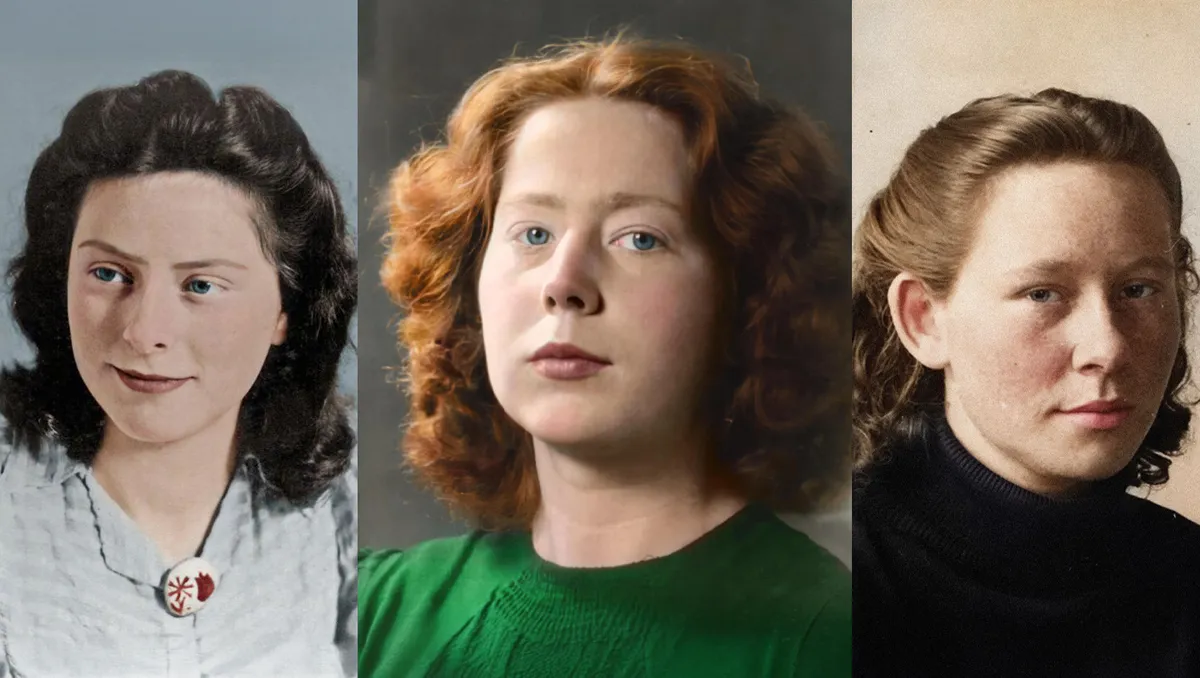
In 1940, three young friends stood where I stood, one with red hair just like mine. But when Hannie Schaft, Freddie Oversteegen, and Truus Oversteegen walked these streets, their Jewish friends weren’t allowed to walk beside them. The Germans had invaded, and the Holland they knew was rapidly changing.
These girls weren’t Jewish—they weren’t even fully adults yet—but they were so nauseated by the world around them that they took action. Teenage girls became covert assassins. And their story, told by Sophie Poldermans in Seducing and Killing Nazis, changed my perspective on war, activism, duty, and, well, chutzpah.
Born to Think Differently
The Oversteegen sisters came from meager beginnings. Truus and Freddie were raised by a single mother—an activist, communist, and strong proponent of justice. Hannie’s parents were both teachers, her father a dedicated socialist. The Schafts were intellectuals, and would sit around the dinner table discussing Hitler’s concerning rise to power.
These three teens were primed to be informed and passionate—a powerful combination.
As early as 1934, before the Nazis even invaded the Netherlands, the Oversteegen family sheltered five Jewish refugees from Germany. Hannie was determined to make a difference as well. In 1938, she left home to study law at the University of Amsterdam, hoping to secure a position at the League of Nations upon graduation and to influence the politics she heard about on the radio.
These three teens were primed to be informed and passionate—a powerful combination.
When the World Changed
Hannie’s plans were disrupted when the Germans invaded the Netherlands in May of 1940. Hannie was 19. Truus was 16. Freddie was 14.
They anxiously followed the news and heard the horror unfold: The Dutch Queen had fled to the United Kingdom. 50 miles south, Rotterdam was being severely bombed. 1,150 people were dead, aged 19 days old to 91 years old. The city center was completely leveled, and the Netherlands surrendered.
After the invasion and subsequent coup d’état, the world continued to shift. Just a few months later in October of 1940, all government officials (including professors at the University of Amsterdam) were required to sign an Aryan declaration, proving their Germanic heritage. Most of them signed it.
One month later, all Jews were expelled from universities and Jewish citizens began to be deported. Tensions rose in Amsterdam as blatant acts of antisemitism became more rampant. As laws became ever stricter, Hannie became even more furious. She said, “If [Jews] are no longer allowed to walk through the park, I will not go there anymore either.”

The First Acts of Defiance
From everything I’ve read about Hannie, I’d like to think we’d be good friends. And not just because we share a hair color, but also because I admire her fervor for justice. On February 25, 1941, when the first large-scale protest in occupied Europe took place (The February Strike), Hannie had had enough. She decided to join the resistance.
Meanwhile, in addition to hiding Jewish refugees, the Oversteegens began to print illegal resistance literature from their living room with a stencil machine. Truus and Freddie graffitied resistance slogans around town and distributed reading material.
In 1941, Frans van der Wiel, head of the Council of Resistance (RVV), came to the Oversteegen home and asked if the two teenage girls would formally join the resistance. Apparently to test their eligibility, Frans pulled a gun on the two girls, pretending to secretly be the Gestapo. When he demanded the address of a Jewish man, Truus and Freddie refused to give it to him, and instead physically fought back.
He found them suitable to join the resistance.
On May 9, 1942, when Jewish people were forced to self-identify with a yellow star on their breast, Hannie started stealing identity cards for them. She would sneak into locker rooms, cloakrooms, public swimming pools, and theaters to retrieve them from strangers’ wallets and coats. She delivered them to Jewish people directly or passed them on to resistance organizations that would forge vital paperwork.
By February of 1943, every student was forced to sign a “declaration of loyalty” to the German occupiers. Hannie and her friends refused and left the university. In fact, throughout the Netherlands, 85% of students refused to sign the pledge. As a result, almost all university education was completely halted.
Meanwhile, Truus and Freddie were gaining attention for their acts of resistance. Their mother and brother had to flee their hometown of Haarlem to remain safe.
The Trio of Teen Assassins
The RVV put Hannie, Freddie, and Truus together as a team. Hannie taught the sisters to speak German and English fluently and all three were given shooting lessons.
Their first resistance work was to find high-ranking Nazis, flirt with them, and coax vital intelligence out of them. Sometimes, their mission would be to seduce and lure these targets into the forest where a fellow RVV soldier would perform the hit. For some missions, they would dress in disguise, sometimes as men. Hannie perpetually had her gun in her handbag, just in case.
Their first resistance work was to find high-ranking Nazis, flirt with them, and coax vital intelligence out of them.
They were tasked with assassinating designated Nazi officials and Dutch collaborators. Because of their work, they had to live in hiding (one of those hiding places was the home of Corrie ten Boom).
Their work was so successful that they became known to the Nazis, who then kidnapped Hannie’s parents in hopes of bringing her out of hiding. But Truus and Freddie reminded her how the Nazis worked: they would likely kill her parents even if she surrendered. Her parents were eventually released, but it became increasingly dangerous for Hannie to try to see them.
Tough Until the End
Hannie changed her appearance, even dyeing her famous red hair to avoid detection. But after years of adept evasion, she was captured by the Nazis. On April 17, 1945, Hannie was taken out of her cell to be executed. The Nazi officer missed the first shot, merely nicking her ear. She turned around and shouted, “Idiot, I shoot better!” before she was killed.
Less than three weeks later, the war was over. The Oversteegen sisters survived. But three quarters of Dutch Jews did not.
Their missions, though extremely helpful in the resistance, understandably left them with PTSD and depression. In a letter to a Jewish friend, Hannie wrote, “I’m in a very sad spiritual state … I am considerably less tough than I thought: Being confronted with death was not easy.”
Truus said, “I wasn’t born to liquidate … do you know what it does to your soul?” She painted a clear picture: “A war like this is a very raw experience. While I was biking, I saw Germans picking up innocent people from the streets, putting them against a wall, and shooting them. I was forced to watch, which aroused such an enormous anger in me, such a disgust ...”
When she came across a Dutch SS soldier brutally killing a baby while forcing the father and sister to watch, Truus took action. She said, “I shot that guy. Right there and then. That wasn’t an assignment, but I don’t regret it … We were dealing with cancerous tumors in society that you had to cut out like a surgeon … That is the cruelty of war.”
I can’t imagine the horrors they witnessed. But I’m so thankful for the horrors they prevented.
Unexpected Heroes
Posthumously, Hannie was awarded the Dutch Cross of Resistance, and President Eisenhower gave her the Medal of Freedom. To help process the trauma of the war, Truus became an artist. She ended up marrying a fellow resistance fighter and they named their first child Hannie. Though the Oversteegen sisters passed away in 2016 and 2018, their legacy has continued making an impact.
I think Hannie, Truss, and Freddie’s stories demonstrate how each of us can be used by God to fight injustice, whether it's against our own people or our neighbor, whether it’s big or small, whether we’re young or old, whether we feel equipped or not.
Each of us can be used by God to fight injustice.
Today, as I think of these stereotype-defying women, I’m reminded of how often that’s the way God works. Throughout Scripture, he consistently used the unexpected hero: a young shepherd boy to defeat a giant, a prostitute to hide spies, a man with a lisp to lead a nation, and, my personal favorite, a carpenter to be the Messiah.
Sometimes, the hero is a teenage girl riding a bike, carrying a gun in her purse.

Introducing the Inherit Podcast
Join us for deeper conversations and behind-the-scenes insights into the articles and authors shaping Inherit.

Endnotes
- Sophie Poldermans, Seducing and Killing Nazis: Hannie, Truus and Freddie: Dutch Resistance Heroines of WWII (BookBaby/SWW Press, 2019), 32 (hereafter cited as Heroines of WWII).
- “The Life Story of Hannie Shaft,” The National Hannie Schaft Foundation, accessed January 23, 2026.
- “Heroines of WWII,” 125.
- “The Netherlands: the highest number of Jewish victims in Western Europe,” Anne Frank House, accessed January 23, 2026.
- “Heroines of WWII,” 99; 145; 72; 73.
Meet The Editor


